
Rainbow Secure is not another IAM platform. It is a Cognitive Identity Attack Defense Mechanism — engineered to defend the way modern attackers actually operate: through psychology, AI automation, deception, and scale.
Designed for humans. Impossible for bots. Defense at the identity layer — where every attack begins.
Every major breach in the last five years started with identity. Yet most IAM platforms were designed to manage access — not defend it under active cognitive, AI-driven attack.
Adversary-in-the-middle proxies clone login pages in real-time and intercept MFA codes faster than your SOC can respond. SMS OTP and push approvals are trivially bypassed.
Credential stuffing attacks leverage billions of leaked pairs. Static alphanumeric passwords offer zero defense when the credentials themselves are the attack vector.
Push-notification MFA fatigue attacks are not misconfigurations — they are architectural vulnerabilities. Every major IAM vendor ships this vulnerability by default.
Passkeys and biometrics prove device ownership — not user intent. AiTM attacks and session token theft operate entirely post-authentication, a gap most vendors ignore.
Three uniquely integrated capabilities that no incumbent IAM vendor offers as a unified, purpose-built cognitive defense system.
Multi-dimensional color, style, font, and pattern binding makes every login a challenge only the legitimate human user can complete — not a bot, not a phishing proxy, not an AI attacker. Even if credentials are stolen, they are meaningless without the cognitive visual layer.
Every access event is evaluated against device fingerprint, geolocation, behavioral baseline, and IP reputation. AI-enabled ITDR triggers step-up authentication exactly when risk warrants it — eliminating push fatigue while tightening the security envelope in real time.
SSO across 1,000+ applications via SAML federation. JIT privileged access with automatic de-provisioning. RBAC with joiner-mover-leaver automation. SOC 2, HIPAA, PCI DSS audit trails generated automatically — no manual overhead for your compliance team.
The cognitive binding exists only in the human mind and never traverses the network in decodable form — making every known attack vector against it structurally impossible.
Even if intercepted by a MITM proxy or keylogger, the visual cognitive layer cannot be replicated. The attack model requires intercepting something that only exists in the human mind.
Automated credential stuffing and brute-force bots have no mechanism to reproduce the visual interaction dimension. The attack surface powering 90% of enterprise breaches is structurally removed.
No push notifications to abuse. Authentication requires active human cognitive participation — making passive "approve this" fatigue attacks structurally impossible by design.
The cognitive layer adds a human-bound cryptographic dimension inherently resistant to quantum computing attacks on static credentials. AES-256 protects all authentication artifacts end-to-end.
Okta, Ping, and Microsoft Entra manage access efficiently. Rainbow Secure defends it under active, AI-driven cognitive attack. These are not the same discipline.
| Capability / Threat Vector | Okta | Ping Identity | Microsoft Entra | Rainbow Secure ✦ |
|---|---|---|---|---|
| Category Focus | Identity Management | IAM + Federation | IAM + Passwordless | ✦ Cognitive Identity Defense |
| Cognitive Authentication Layer | ✕ | ✕ | ✕ | ✓ Purpose-Built |
| Phishing & AiTM Disruption | ✕ | ✕ | ⚠ Passkey flows only | ✓ Architecturally Blocked |
| MFA Fatigue Attack Resistance | ✕ | ⚠ Number matching | ⚠ Number matching | ✓ No Push to Abuse |
| Bot & Automated Attack Immunity | ⚠ | ⚠ | ⚠ | ✓ Cognitive Binding Blocks Bots |
| Keylogger & Credential Theft Proof | ✕ | ✕ | ✕ | ✓ Visual Binding Non-Replayable |
| AI Identity Threat Detection (ITDR) | ⚠ Add-on pricing | ⚠ | ⚠ ID Protection addon | ✓ AI-Driven, Login-Centric |
| Offline MFA (DFARS NIST 800-171) | ✕ | ✕ | ⚠ | ✓ Online AND Offline |
| Enhances Microsoft Entra | ✓ | ✓ | — (native) | ✓ Cognitive Security Broker |
| PAM — Privileged Access Mgmt | ⚠ Add-on | ⚠ | ⚠ PIM module | ✓ Native, Integrated |
| Attack Economics Disruption | ✕ | ✕ | ✕ | ✓ Core Design Strategy |
| Designed for Human Cognition | ✕ | ✕ | ✕ | ✓ Foundational Architecture |
| SSO / SAML / OIDC | ✓ | ✓ | ✓ | ✓ 1,000+ App Ecosystem |
| User Lifecycle (JML) | ✓ | ⚠ | ✓ | ✓ JML + JIT Automation |
Three integrated pillars — no feature gaps, no separate vendor contracts for PAM, ITDR, or compliance logging.
Multi-dimensional color, style, font, and pattern binding makes every login non-replayable. Works online, on-premises, and fully offline for DFARS-covered environments.
Identity Threat Detection and Response embedded in the authentication layer — not a separate product at separate cost. Real-time AI analysis on every login event.
Enterprise-grade access governance that integrates with your existing infrastructure — deploy as primary IAM or as intelligent security broker over Entra, Okta, or Google.
Microsoft Entra is powerful identity management infrastructure. But it was not designed to stop cognitive attacks — phishing kits that clone Entra pages, bots that replay Entra tokens, or AiTM proxies that steal Entra session cookies.
Cognitive Identity Defense delivers the compliance depth, attack resistance, and audit trail profile that regulated industries require — without operational overhead.
Cognitive MFA eliminates the fraud vector of intercepted OTPs in wire transfers and privileged admin access. Step-up authentication for transaction approval — no hardware tokens.
Enforce least-privilege access to patient records without clinical workflow friction. HIPAA-compliant audit trails generated automatically for every joiner, mover, and leaver event.
Full DFARS and NIST 800-171 compliance including offline MFA — the only architecture that meets DoD's requirement for authentication in disconnected and classified environments.
Lock down privileged admin access and API service accounts before your platform scales into enterprise territory and the attack surface explodes. SOC 2 Type II by design, not retrofit.
Protect IP, clinical trial data, and research infrastructure from nation-state credential attacks. Role-based compartmentalization with FDA 21 CFR Part 11 electronic records compliance.
Protect research networks, student data, and grant-funded infrastructure from ransomware and credential phishing — the top attack vectors for academic institutions globally.
Cognitively. Creatively. Continuously.
Easy for humans. Impossible for bots. Hostile to every known identity attack vector.
FROM THE BLOG
Insights on moving beyond passwords and building phishing-resistant identity.

How One Company’s Identity Security Journey Could Be YoursMonday mornings are usually busy.For Mark, the IT Director of a growing manufacturing company with 1,200 employees, Mondays were chaotic.Employees…
Read More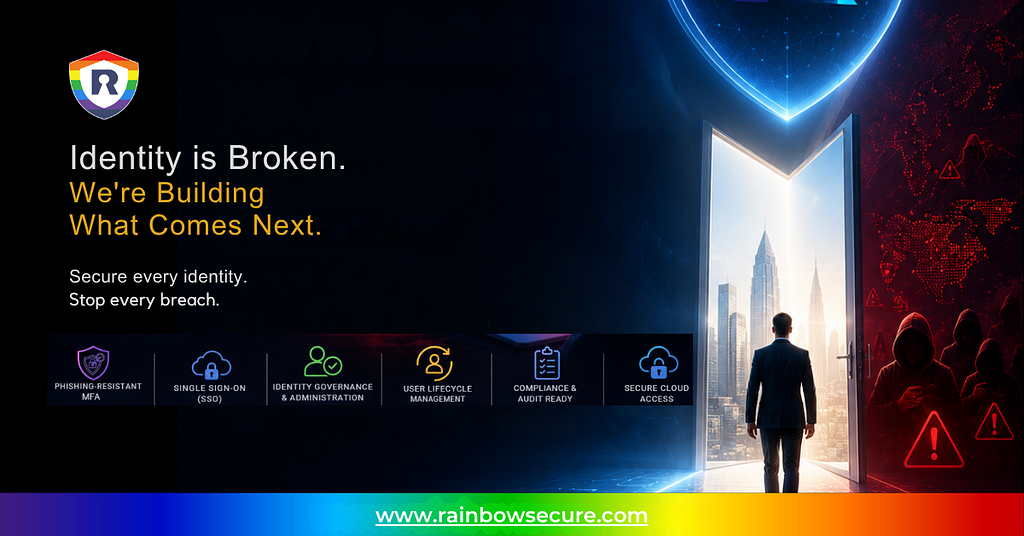
Why the future of cybersecurity isn’t about stronger passwords , it’s about eliminating the conditions that make attacks possible.For decades, cybersecurity has asked employees to become…
Read More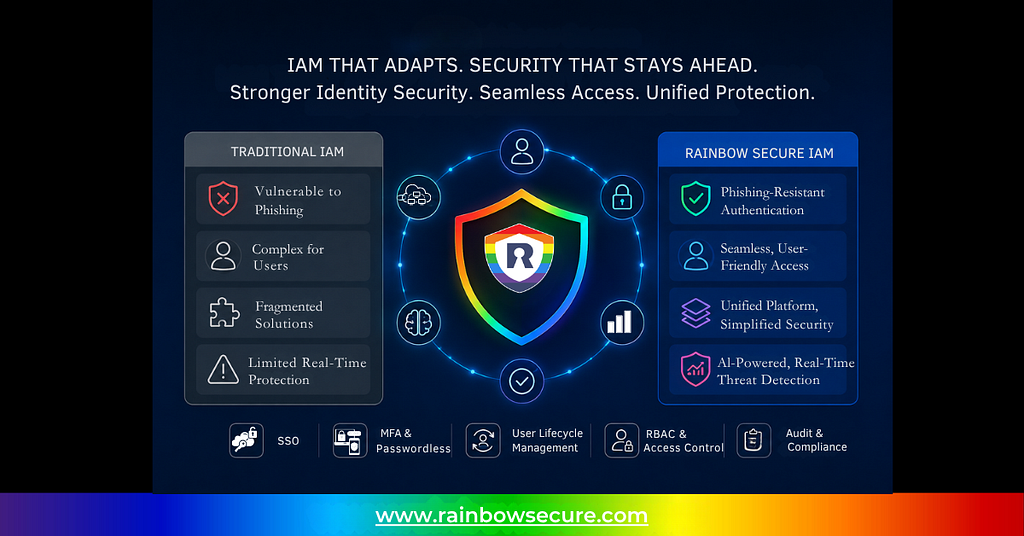
Why Traditional IAM Is No Longer Enough: How Rainbow Secure Is Redefining Identity & Access ManagementIdentity has become the new security perimeter.As organizations continue moving…
Read MoreEXECUTIVE TALKS
Learn from industry experts about identity security, phishing protection, and cyber resilience.
By Dhaval Shah & Nehal Mehta
Watch on YouTubeBy Dhaval Shah & Nehal Mehta
Watch on YouTubeBy Dhaval Shah & Nehal Mehta
Watch on YouTube